
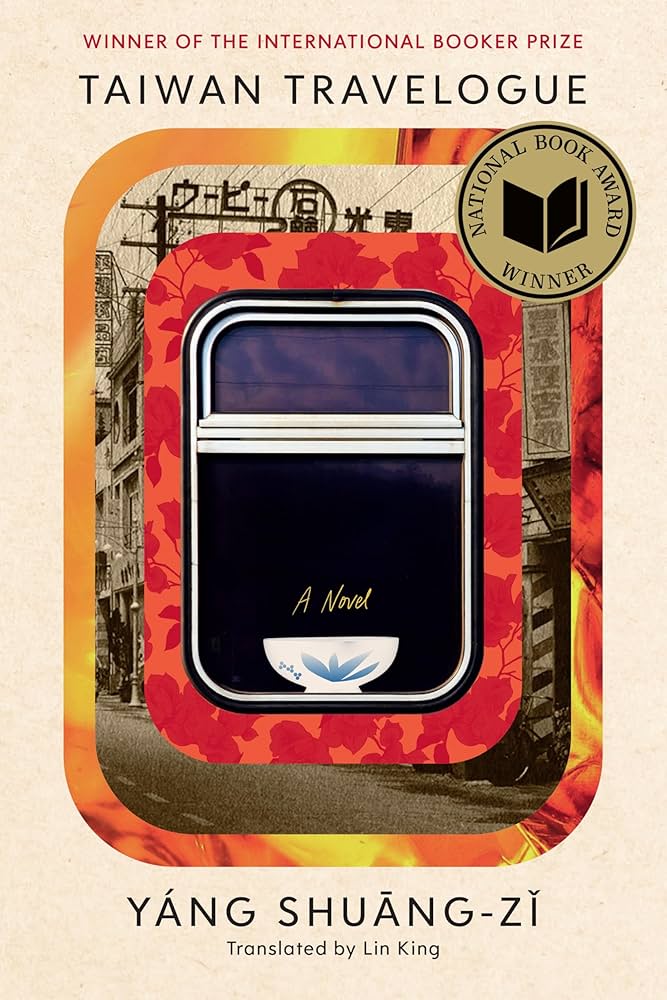
Book Review and Critique By Harsimran Kaur | Rating: 5/5
International Booker Prize 2026 Winner
Let’s start by discussing the friendship that ensues between Aoyama Chizuko and Chi-Chan. Aoyama has been invited by the government of Japan ruling Taiwan to confer to their imperialist agenda. She has no interest in the political fragment but wishes to explore the island. Chi-Chan is from Taiwan, an islander, who eventually becomes a translator-interpreter to Aoyama. It’s their friendship that must require our contemplative power to discern the crevices in humanity and what it takes to put it together. Through them, one sees a creditable friendship blooming, disparting a sense of familiarity but with a conviction of prepossession.
Now to take it further, isn’t there a distinct appeal to certain friendships like we see between Chizuko and Chi-Chan? In their performative grandiosity, grows a peculiar comfort, a profundity to express, and such expressions in the distilled storm of sentimental yearnings opens an association where the whisperings, mutterings, repeated reasonings not only form a part of communicative opulence but determine the certainty of human compassion in its mysterious power. Somewhere then the reality feels more real, reckoning and then the force of such friendship is ominous; a distinguished affection.
So, I see a friendship re-created where dilemmas are no longer deviations and where the ceremonial intrigue to know one another is not justified in a moral compass, and now I observe them; Aoyama and Chi-Chan, as if disquisition flows without class drifts. It looks as if the incongruity of discrimination has taken a pause, and nothing is now left in esteem of condescending morals when belonging becomes liberating.
Can such friendship between a writer and interpreter decode the rationales and reasonings of philosophical depths of the vague, abstract, unfamiliar, and if it is possible for the writer like Aoyama to interpret the purge, the quietness and the apprehension, the inhibition of Chi-Chan? So, are we looking at a role reversal here? If Chi-Chan was a writer, will she intrepidly write of Aoyama’s concern & compassion, or will the resolve of an Islander carrying a restraint for decades, in her impressionistic wisdom, insinuate the irrational disparagement by the mainlanders, that Aoyama is?
So, we have formed a very important point here. But there ‘present’ is enthusiastically eating into a variety of foods that Chi-Chan introduces to her esteemed writer. Aoyama is thrilled & quite adventurous to experiment such delicacies. Now here, food brings in the question of appetite. Conformity to appetite is dubious, isn’t it? Some have a large appetite for food, life, love; some wriggle in one corner, starving because hunger for life has vanished or there is hardly any resonance to such an appetite. Such elemental ambiguity delves further into suffering because a disagreeable appetite stems from dull monotony, a remorseful tragedy or a discreditable melancholy. So, through such emotions, is it possible to stay alive? Does all this become a motive to conquer the absurdity to hold life in a vast expanse, ravenously eating the portions of uncertainty?
I don’t know to what I contribute the excessive appetite of Aoyama to? An irony of eating—the desire sometimes surpasses what actually has been eaten. And, when she talks about privacy of the mind, the selected solipsism of the mind towards wating is an integrated commensality.
Aoyama Chizuko is full of peculiar humour; in humour there is no caution, and I wouldn’t say that humour is callous but it is irrational otherwise the comparison between Aoyama and the Great Cedar that she is frequently referred to in the book, seems redundant, and it is easier to turn it into a conspiracy; the validity of humour is such.
When Aoyama wishes to have the Taiwanese delight and is bereft of it, one sees around this displeasure a satirized humour as if to be not allowed to taste the local eatery is tantamount to philosophising about life & death. On the flip side, Chi-Chan is composed. She addresses Aoyama with sentient reverence, and thereby brings in for her what she wishes to eat, and all this is layered with conversations between them, the necessary arguments and now she shows this relevant curiosity to reason the malfeasance, the uncertainty, the egregious manoeuvres and the cultural chicanery of the human mind.
There is this utter promiscuity of food that is perhaps a voluntary debate between them as if it were not food but a verbal erudition of human behaviour; its tenderness, the amusements, unpredictability. Food can be notorious and can be doubtful. Often, one doubts if the ontological interest in oner another is obligatory or suffocating or can bring out an all-pervading sustainability, a belonging? And this oblong meditation of human mind fixes me to the reference of Buddhism in the book, which talks of the three poisons; greed, hate and delusion. I wish to add another which is the over-indulgence of food.
Food id cryptic; what goes inside, relished or unrelished, carries a metabolic algorithm to manifest its gustatory pantomime, and then more is demanded. The more is needed because the sensory pleasures of humans are unimpeded, and therefore, food becomes a passion for some and for some a liability. I have experienced ‘food’ not as fondness but as an accessorized sadness that finds no solace inside my body. But there are many who find aesthetic perfection in food that holds the secrecy of mysticism that is about to reveal as a demonic or rather a curatorial satiety.
Taiwan Travelogue by Yang Shuang-Zi is a worthy take on humanity, the curiosity that one person has for another, the other’s belief, their circumstances, and then then comes compassion or there could be unrestrained disregard.
But in this curiosity lies ‘prejudice’. The entire cultural vitality of Islanders, Chi-Chan being one of them, is subject to imprecation. However, she is less intimidated by such prejudice. In fact, she is wry or a bit sardonic, and is aware of the slight when she is addressed as ‘Li-Ya’. She is also quick to respond rather affirmatively to the distinction between Islanders ‘chosan’ and the Mainlander’s ‘Kimono’. Aoyama wants her to wear the Kimono. Isn’t this hints at prejudice? Chi-Chan is awkward at this moment, shows defiance and then accepts. So for Aoyama, Chi-Chan’s morality, her occupation, immutability, her silence, the recondite becomes irrelevant. But, it looks that Aoyama in the process of contouring the rigged lines of discrimination appreciates the effort of her interpreter.
Would we call this functional optimism towards life, towards people where the discernment factor plays an important role?
But, Aoyama calls this ‘protection’ which forms another aspect of curiosity in the ‘other’, the first one being ‘prejudice’ as discussed above.
‘Protection’ is a mechanism to shield the unresolved, the unhealed version of you, and such distortion where human mind feels threatened, there exist doubt, and once such conflict sets in, the repulse, the rebel takes the form of protection.
But why there must be a resolve, an almost a punctuating decency to protect the other; ebbing and returning? Is it to prove oneself to be worthy of humanity? However, if such protection turns out to be an imposition, and the ‘other’ may think of it as a conspiracy, a superfluity when it could only be a reasonable concern to identify, and in such case, I must say that the idea to protect another also relies on intuitive judgement and when one does identify with the other’s uncertainty, then arises an impulse to protect the intransitive sorrow which one does and is quite evident in the relationship between Aoyama and Chi-Chan.
I would call this protection as solicitude or epistemic trust.
Then also arises the question of perception.
Aoyama considers Chi-Chan to be both an angel & demon. Many times, she feels Chi-Chan is wearing a Noah’s mask. She is called a white phoenix by Aoyama and that she should not settle for a lesser life. On the flip side, Chi-Chan has lived with a perceived consanguinity of how Islanders are supposed to behave; obeying the regional divide, the diminishing alliances, and therefore does not look for reassurances.
As I went on to read the book, one sees a pattern of perception being formed every now & then. And, if I were to reflect, I see perceptibility as very shallow for it is only inclined to self; very self-absorbing & what we perceive comes from our own limited knowledge of the ‘other’.
The question now arises if the Islanders only require protection, to be defended but doesn’t the monotony of such expressions fail to reason the matters of worthiness and of their characteristic strength? At this point, more than protection, Chi-Chan, an Islander requires an eclosion, and it looks as if Aoyama, a mainlander, is trying to distil a zeitgeist of change.
The displeasure thus exists, not arising out of disinterest or disregard but a vague unfamiliarity of the ‘other’. What concludes in such interactions is a beleaguered exhaustion & a scandalized sorrow. And one sees in Chi-Chan such an emotion, looking for redemption as if she has already approved the predictability of the people around her. She does not show disapproval to their impertinence, and if her being human is against humanity and is she deserves compassion, it will be an incommensurable crevice butting in her native pride.
But in the end, one sees an extra-ordinary friendship, a distinct appeal of such a friendship between Aoyama and Chi-Chan.
In their performative grandiosity, grows a peculiar comfort, a profundity to express, and such expressions in the distilled storm of sentimental yearnings, opens an association where the whisperings, mutterings, repeated arguments are not only about communicative opulence but determine the certainty of human compassion in its mysterious power and not in imagination. Somewhere then the reality feels more ‘real’, reckoning & then the force of such a friendship is ominous; a distinguished affection.
5 Responses
We really liked this; it is a high-quality book review.
I have read this book review very carefully, and I liked it very much.
I had been looking for a book review of this book for quite some time and found it here; it is very well written. Thank you for providing it.
This Book review are very nice and creative
Book review are very nice