
Book Review and Critique By Harsimran Kaur | Rating: 5/5
Can a revolution be melancholic? The heart that melts into the roots of disdain, dilapidation, and then we see a complex quandary of resistance. And why does the heart melt? It resigns to ‘love’, and if the lover that one does not see coming, and is still felt inside the heart, one must embrace it. Revolution is born from a presentiment, and if revolution is the ‘lover’ that must be reclaimed, then ‘love’ is not a pleasure but a shift in perspective. Revolution is thus longing of the true love.
And then what should be an idealistic revolution?
One that resounds apoplectic screams and unrestrained vehemence, and then to bring about a change, if it does become necessary, would such revolution become a matter a belief, and if in such preponderance, one analyses that the structural and the fundamental reasoning for existence; unresentful and unguarded, is to create an identity, then a spiral of rebellion is invoked to protect such identity, and then it does not remain a belief but a self-styled narrative.
Was the Iranian Revolution a propaganda or an incendiary simulacrum of such a narrative?
There is an incarceration of essence within the self, as felt by Behzad. A performative agony rises in him; a disturbed milieu of discontentment has ensued as the revolution, once to be reflected through shared bonhomie, has been chopped off, and now what remains is the left communist on one hand and the Islamist clerics on the other.
So, If I may ask, is revolution an apparent claim to liberation where the self is mobilized for the greater cause, and If I were to extrapolate the cause, will it transpire as a befitting reply to scandalized morality? As we see in the book the comrades run in a supposed determination to build an Iran not impregnated by the western influence, and then such a revolution turns into a distortion, a flaw, when the political reasoning, with the ‘Shah’ escaping and the ‘Islamist Regime’ taking over; such reasoning turns into a religious doctrine, then isn’t it mercurial assault of the very orifice of such a revolution?
Can Behzad ever escape the imprisoned warrior that he has become beleaguered by the conscious of resistance?
In the current US-Iran imbroglio, the context of ‘The Nights are Quite in Tehran’ by Shida Bazyar sits perfectly among the cluster of reprisals and recriminations. A flicker of resonance persists as if all that has happened in Iran, last 40 years, now ignites intrepidly in my conscious and in the sharp wisdom of historical truths, the idea of ‘freedom’ and the intent of the people of Iran to deprecate such oppression becomes clearer.
So, is revolution always empowering?
Behzad is a comrade; has taken up arms but it’s the internal defeat of the conscious that fails to conquer such ambiguity. What he sees around is an air of resentment, a disruptive rigour and a resistive, rusty loneliness that the revolution has brought about.
A colloquy of ‘love’ has surrounded Behzad, of a woman and of the appendage of such a revolution that is soon becoming an apostasy of moral determinism. So, what is an ideology? Is it the contemplation of self-sustainable goals, and now Behzad sees religious autocracy by the Khomeini regime that would become the new demagogue. And, here I would like to delve further on the human psyche around ‘change’.
Behzad now lives in Germany, in exile. And the conversations between Behzad and Walter catch my attention. There is an intimidating vulnerability that surrounds them, of their responses and what surrounds them at present; there is an ‘uncertainty’ why a revolution becomes necessary?
The Islamist Regime after the Iranian Revolution stigmatized the voluminous fantasia of human mind. Behzad, a comrade, could sense the portentous debacle of its effort, and such a revolution that stems from the idea to build a country impressionistically; the nuance captured by the regime rather perfectly. Now, the left extremist had to become expatriates, and to speak loudly about it would be a blasphemy. Both, Behzad and his wife Nahid leave the country. Would we call this expiation or along they carry the memories of prevailing zeitgeist?
What does such a revolution curl up to be when its alterity of ‘other’ becomes prominent, and under such ethos, emerges a threatening antagonism for the ‘other’ when they are actually the people of the same land?
What I see it as is a meanness straining into a convoluted spiral of hope & belonging, then the eccentricity of religious monologue cuts a political charade and an intimate propaganda. What then becomes of the revolution that started with the expulsion of ‘Shah’ and is now a self-stimulated paradise, and then what one sees is a lack of vitality because such a revolution is heroically impulsive but morally malignant.
This revolution is in the mind with no end. It continues through the indelible mettle of the children of Behzad and Nahid; Laleh, Mo & Tara.
Laleh travels with Nahid to Iran for a short vacation. Laleh feels a sense of belonging; an intriguing curiosity to know the world of one’s roots, and If I were to say that roots once cut then what about the plough beneath; can it ever disregard such separation? What were to grow from such roots if it were not cut, and then we see a self-deprecating stem uprooting the structure that carries the mystery of unmoored rootedness?
Laleh, in Iran, tenderly sways in such unstable belonging, indomitably trying to understand if she has something to offer to her ancestral land, and in case some anomaly has knocked to starve her off her connection with Germany? And one must learn through her journey how she is drawn to this land and its people. One sees that her true anchorage stems from the systematic belief to surrender to the imperishable sadness, to the conspicuous laughter around the people who in their unfamiliarity, and in their peevish anonymity find Laleh one of their own. Thus, she is drawn to them. Here is how I would define her belonging where around these obligatory associations to the perfect melody of the stars & the brightness suffocated in the darkness, and in the sheepish quietness where the soul resides carrying the incongruity of human distortions, and the melancholy that breaks in such quietness, there is a familiarity that is felt by Laleh, and thus she belongs.
To further reflect, belonging is never without memories. Memories have power, isn’t it? Then how is such power lost?
Is it through abandonment of beliefs; it’s the disruption of such beliefs that humanize the eccentric monotony of life, and the letting go of beliefs that feed on tender spirituality, and now I see such beliefs crashing, and this is what Nahid feels when she looks back at the memories of Iran, and there are many such memories like a simulacrum of defined appearances—of mother, father, sisters, nephew & nieces left behind. The beliefs left behind, the cultural ethos diminished, the patronizing flavours reduced in sharpness, and the sentimental grandiosity now flooded with a warning to veil the reasoning of such impressionism that made homes lose their sons, created prisoner of wars, and such esoteric distance of beliefs between the stories of Iran and Europe; does it then make memories a spoken curse, disrespectable? Or to revive them becomes a cultural necessity?
And in the wonder of such memories, beliefs exist, thus power reigns.
Behzad feels powerless in the land of exile as if redemption is waiting for a comeuppance that was otherwise never a deserving determinist.
Now, there is a very interesting and revitalizing conversation that I picked upon when Walter (Behzad’s German friend) tells Behzad and Nahid on reading ‘Brecht’,
“You pick up things you like, no matter where you stand politically”.
I find two inferences from it. The readers might agree or not.
One—that ‘politically motivated’ are those actions and words that are contorted to suit one’s perspective as politics is about power, and power is not for the servile, and power is lethal and it is quite predictable of political pragmatism to turn monstrous.
Two—a mind can be political inspite of not being a part of the political party. The mind is thus at exonerated liberty to build views, and thus splurging a smut of idiosyncrasies like a weaver weaving an abstraction fuelling his creativity with presumptive logics, and in autonomous impulse stitching a boundary of his sculpted reasoning.
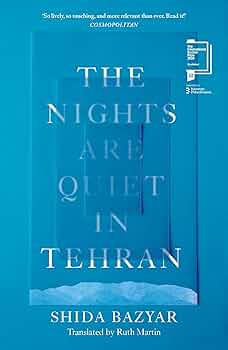
‘The Nights are Quite in Tehran’ by Shida Bazyar is a beautifully curative assemblage of belonging & patriotism. The nation thus becomes a ‘lover’; the body bruised, the skin shredded & bled, and the idea is not to covet it but liberate it from the dystopia.
One such occasions, when Nahid and Laleh arrive in Iran, the atmosphere is serene and peaceful. But, here, in the indigenous land, Behzad is celebrated as a martyr. He is not a martyr but has been made by the people as if death is an awakening, and Behzad today remains a ‘sacrificial truth’ all these years, away from his land; and in the land of Germany, he still stretches often in remorse, often in a deep stare to cut with a gleam the forbidden, and the crackling, whipping of morals. I then feel that these morals have defined the revolution for so long and still do, and this ‘revolution’ has sometimes bedevilled the anger and casuistry, which is unbearable and has made him a martyr when his escape from Iran was a psychic liberation.
‘The Nights are Quite in Tehran’ is a voice of the people fighting for freedom; a freedom scattered like the tiny shards of broken glass, crushed by the unrestrained malice of the Islamist Regime.
It is a monotony, melancholy & mortification felt by the people of Iran as if their reasoning to live, survive lies in moribund, and such distress is visible through the silent awakening of Behzad, the deformed happiness of Nahid to leave a home in the shadows of acrimony.
It is a reflection of youth who still carry in their hearts an intimacy to their inventive pleasures to continue to fight for liberation; to let the revolution once started by their parents grow unhindered. To hold placards, to take to streets; and if all this is superfluity, and in such immersion of revolt, one sees the profound contradiction, so ghoulish and complex, and then to wait for the darkness to dispel, and now that Laleh, Mo & Tara witness around the profundity of the ‘Green Movement; thus becomes an imposing backlash.
The youth, the people of Iran must through their impressionistic fervour fight the fatigue slayed over them. Let the intentions cut the cords of reticence, and all the scepticism and humiliation, and the swelted insolence they have suffered should now leave the exhaustion, and now they must strive in precision to let freedom whisper its muffed melody.
9 Responses
It is an excellent book review; we really liked it.
The book review was excellent; one rarely sees such honest reviews—the kind written after extensive study. It was truly impressive.
This is my favorite book. I really enjoyed the review of this book, and I would like to read similar book reviews in the future as well.
This was a very good book review; we really liked it.
This is a very interesting review of the book.
excellent book review *****
It is very good.
You have written a very good book review; we really liked it.
Great post,Thanks for sharing