
Book Review and Critique By Harsimran Kaur | Rating: 4/5
Why prayers remain unanswered? Is God absent; Is there is no one to listen to our prayers or the obsessive fury to covet something is not pleasurable to God. It could also be that God does not want to see us as a parasitic, and we know it is not always that prayers will be answered but the discretion to be naïve is a way to please God, may be!
Mayya is dismissal of what she prayed for; she is now married to Abdallah, and the love that was never hers drowned in the lambency of prayers. So, ‘love’, even if it is there, it has its reasons to dissolve, to decay, to dismantle. In the plush of ‘love’, lies the obscurity of its intention. The ‘love’ of Mayya and Abdallah is fundamentally pure, no question of purloin or defiance, and that such love is not a complex phenomenon, and it exist because it comes easy, was never prayed for, and therefore grew in the penumbra of adequacy.
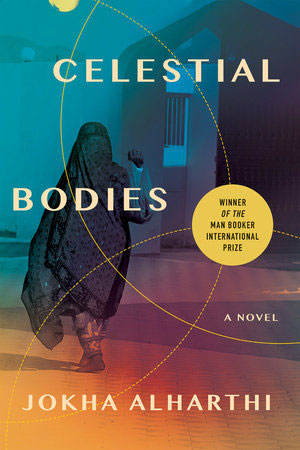
‘Celestial Bodies’ by Jokha Alharthi is about silence, awkward, often creeps into our spaces and becomes a part of our extrapolations.
Mayya is sensory in her silence or she gradually becomes one, or one becomes silent when prayers are not answered. She lives in her silence but is living to be alive? The disturbing shrills and shrieks of the vicissitudes of her life; she sees such silence becoming. It’s a perfect impunity.
In such silence is born motherhood, of ecstasy and reluctance. Are mothers dishonest to themselves? The privilege to be a mother; to impugn such privilege is a matter of debate. To answer the demands of cultural consanguinity, the mother, in such privilege, is wounded in the cathartic wedging, dispersed in the vitality of judgements. So, can we say that in the implied morality, privilege continues as a contrivance. Salima is a mother to Mayya, Asma and Khawla. Don’t all mothers, like Salima, carry an imperturbable silence, and if it insidiously reckons to tear us apart, are we not all chameleons camouflaging the silence by disorder, disruption and drudgery?
Then, there is Asma. To read about women like Asma, I often think what possibilities a woman has in the life’s abstract monotony and depressed surveillance? Does she become a persistent reckon to life’s lethargy?
Asma is not a dismissive wife but is dismissed by Khalid’s monopoly over such life which only belongs to men, their fundamentals, their ubiquitous anomalies, and through such a labyrinth, a woman like Asma must travel in her silence to mix her essence with evanescence, and she does, and if such propinquity to man’s world disturbs her flesh & soul, then she must not act in revulsion, because such recrimination is blasphemy; she knows it, and in the man’s world, what would be the decree given to a woman?
There is despondency around a woman’s life, so such magnitude, that she mustn’t realize because if she does, she would lose her mind so she chooses silence. Through such silence, there is a perturbing soliloquy by a woman, and that’s a call to herself because the incense of her shredded past, a lost lover; the wait and the wailing and the restrictive existence is a putrid tragedy. Men call it unfamiliar stupefaction…
But can men be emotionally assailed?
Abdallah recalls being brutally beaten by his father for misbehaviour during his childhood, but when his own son comes home in an inebriated state, Abdallah has a flashback of the deprived memory, but the question remains, do ethos change? Yes and no!
There are morals to be dealt with; ethics become determinist, and how we act is presumably our characteristic disposition, and when we act, we form an ideology and such repetitive acts of rebellion or impulsions make us who we are. We see Abdallah trying to understand his childhood through his children. Even cultural asperity down the ages has punctured the mental capacity of human mind like a needle stirring holes in the otherwise restored cloth. And such appurtenances, the ones we carry to act, gradually become a liability.
There are examples…
A black kohl for the new born, an amulet for the ailing & diseased, a married woman with a red vermillion, and here I must go back to Asma because when she shows defiance to an incense put on a bride, she is suppressed for her impertinence, and would such cultural propensity add to the schism she feels inside or would she settle to a cultural design?
Khawla shows the impetus, the courage to defy the odds. But what she gets in return is parsimonious love from Nasir. The loops of the past unfold for Khawla; the ‘Laila’ in waiting for her ‘Majnu’. Her discordancy to habitat such a long-lost love is in disagreement to the ordinary mind but she feels pleasure in the pursuance of her mind to only get married to Nasir.
What makes women like Mayya, Asma and Khawla common to us?
Aren’t we all suppose to be women of virtues? As long as we are limited to our observance; to observe the coloured walls, paint them in the ambiguity of our liaisons; as long as we observe the broken windows, and in the unconscious serendipity of such eclosion to spread our wings and fly, we see the window only remains broken and then we see a sparrow beating its wings at the edge and we know that it would fly to not let the coerce glass prick its fragility. But somethings sews inside us, a soporific suffocation, maybe. As long as we see the unlatched door and show the resistance, and in such proximity of freedom, we choose a tiring imprisonment, and as long as we blindly stretch through the symmetries and asymmetries, we are the woman of virtue because that is what a woman is suppose to be, and if such observance, through poignant edification, becomes vocal, we become a malignant obscurity around the patriarchal fiefdom.
Do I call such vulnerability as an ornamental fragility?
Thus, arises a bigger question,
A woman’s life is handcrafted to suit the structure of arms that hold her as per fancy. Her sentimental convulsions, the disturbing devour of her flesh and the psychological despair, and the absolved hunger invading her gut, and still if she is required to wither in the perplexity of cultural consanguinity, will she be permitted to act in accordance to her will?
What about women as slaves?
Concubines or slaves? Do we question the perceptibility of men here or their intemperate dispersion to flesh? Freedom becomes a debilitating commodity; and therefore, this battlement of slavery and freedom; is it in the mind, and what so we see outside, is there something forbidden about it, to sledge it in the paramountcy of master-slave imprecation?
Zarifa—the woman, the slave; how would she describe a justified life; of what she knows about adequacy, and here are we saying that all women are slaves because all women are inadequate?
There is a constant belie in such associations if there is an evil spirit intended to destroy the dynamics. Women are looked in blighter; most of the time. Their response to ‘love’ belches arithmetically, and then the bilious, a very loud & mournful rising to the throat, and what rises is a drained consummation of life. Is it a brazen reality? Life is given to us, to the women, not piteous but the way life is supposed to be. Of what we make out of it; see us as the disruptive, the disintegrated and the desolate; isn’t it a disparity compared to men?
The lesson is that more we abject life to, the life within us sings the same tune.
- Mayya marries Abdallah—it is moral acquiescence but the ‘love’ that once left with incomprehensible suddenness, is it still easy to slough off the skin? Th aftermath of such separation is a restlessness that negates the ‘normal’. She keeps the name of her daughter ‘London’. At least the name is devoid of virtues. ‘Mayya’ means attachment, and attachments are forbidden but still ‘Mayya’ is a name credited to a woman. A name called ‘London’ will not make her walk on the London street. Names are hypocritical indeed!
- Khawla; how besotted she is in ‘love’—Does such love engender redemption or a reprisal? Love can be fatal too. Waiting for the one you love could be detrimental to the entire humanity. Khawla waits for Nasir; a longing she must put an end to.
- Asma is beleaguered in ‘Love’—she is there in fresh & soul for her husband ‘Khalid’ who in the reticent silence of his past paints an impasto of a shadowy belonging.
‘Celestial Bodies’ is an awakening to the truth; and in its dulcet and dullness, there is the perpetuity to not face it. We are all an enigma, a puzzle, and how we solve that puzzle brings us close to our past, and then we wish to find a pair of scissors to shred it into pieces, and when we are unable to do so, and in such propinquity, we lose track of the ‘present’; grief comes in, and the future now seems discordant, and the alignment of all three is ‘LIFE’.
4 Responses
I have seen many times that the quality of all the opinion articles that appear on the website is of a very good level, they are very clear, neat and clean, thank you very much for providing this and I would always like to read it again and again.
This book review is excellent and very clearly written.
This book review has been written after a lot of analysis, it is very clear and good.
I must thank you for the efforts you have put in penning this website.
Iam hoping to see the same high-grade blog posts from
you later on as well. In fact, your creative writing abilities has
motivated me to get my own