
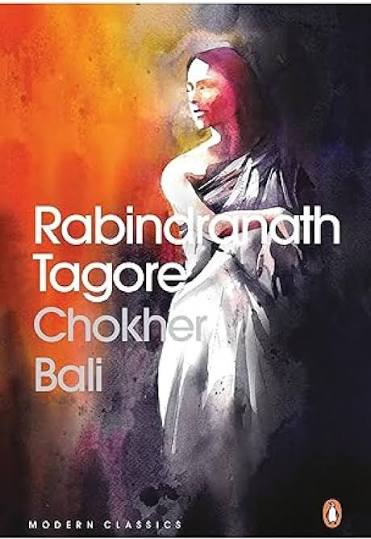
Book Review and Critique By Harsimran Kaur | Rating: 5/5
Here, I would explicitly talk about the intentions of Asha, Mahendra, Binodini and Bihari—the four main characters in the book. The story is complex but there is a flamboyancy of characters, often indiscernible in their attempt to know each other, and in the course of their transitions, one is tempted to rise through indubitability to implausibility. Nothing is mechanical about them; in fact, one sees a self-deceiving, wild and an all-permeating contradiction of one’s own intimacy, swayed and swelled in exhausting moments of self-reflection.
Let’s start by talking about ‘love’. In Rabindranath Tagore’s ‘Chokher Bali’, the colossal contouring around ‘love’ becomes a layered possession of insecurities. One these sees this ’love’ progress. It’s a deep dive into imperfection; a dive into an imperceptible disturbance around idiosyncratic flooding—the noise of which is unheard but what plays behind this restored belief is the cantata of calumnies which one day could make you deaf. It is also a dive into unprecedented visions where betrayal looks luxurious. Then one may call ‘love’ unfavourable and that may have to do with subliminal perception.
One finds such love around the faultlines wired by Asha, Mahendra, Binodini and Bihari. This ‘love’ is amusing too as we see temptations become a rudderless boat striving in a direction, unknown.
But then one questions; why does such love exist?
- Is it fondness for such love, where two people enjoy the bliss because they have to?
- Or, such love must be ordained to dominate over the other’s inadequacy, which one sees in Mahendra’s attraction to Binodini.
If now one were to compare, Mahendra’s love for his wife Asha is confined to the sanctified pleasures, and his love for the widow Binodini is devotional, and such devotion by Mahendra is a solipsistic obsession which is met by sclerotic disavowing.
Torn between his love for Asha and Binodini, I am alarmed by Mahendra’s innocence containing his obnoxities. Is this innocence partial, prejudiced or does it lie in casuistry?
Mahendra, in such innocence, is failing to love as if love is a demonic spectre of witchery, entangled in the agony of charms & spells. This unrestrained innocence of Mahendra arouses a hypnotical verse deluding his essence into condescending watchfulness. The love that he sees; the love he aspires is a kind of liberation from physical and emotional monotony. But amidst all this, one feels an annoyance towards ‘love’.
Asha, Mahendra, Binodini and Bihari—they all love in a way as if they fit into a self-created web of presumption. Asha loves Mahendra with honesty, and often stumbles into his trap by her frazzled determination. Can women like Asha be easily deceived by men for their sudden inclination and abrupt determination? On the flip side, Binodini is charismatic. Though a widow, her disparagement becomes her isolated territory from which she must come out. And, in order to be extricated from such disparity, she settles under the carapace of ‘love’; a love that becomes vengeful and unreasonable. Reasoning such turbulence, I feel that love such as of Binodini does become a potential threat.
Do both Mahendra and Binodini feel this unstructured repetition of senseless emotion; an unrecognition or a surfacing uncertainty around Asha? I see betrayal and bemusement around such love.
Rabindranath Tagore mixes provincialism and iconoclasm in the 19th century Bengal. It exposes the feeble condition of women like Asha and Binodini who get married at a tender age of 12-13, tending to domesticity. With such nonchalance in place, at that time, there was already a patriarchal prevalence, shaking the prosthetics of radical freedom for women?
But again, here the volition is also a precinct of determinism which Asha and Binodini demonstrate irrespective of the puritanical around the immutable palimpsest. It thus brings to my mind to show such compassion to both Asha and Binodini, and certain questions linger,
- Why a woman is disparaged?
- Why a woman is tormented? She is surrounded by calumnies not because she has committed an error but because of moral obscurity, and such is a woman’s plight that the ‘right’ and ‘wrong’ just become a grandiose liability.
It is an abstract injustice to women of what Asha goes through. The rationale loses its significance. It looks as if the rhythm has faltered, the sound is broken, the cords & strings are entangled and yet the song plays. It is no longer mystifying, but it must continue to confront the ears that listen to it. Why then Asha must clog her ears? Would her languishing distress go away? When Mahendra leaves her for Binodini, is the separation a loss of association or a continuing of abject belonging?
Binodini is privileged, not socially, culturally, morally but she is privileged to understand the intrusion of human discrepancy. She lives vicariously, a regression into the lives of others to build a life through the scattered truths of Asha, Mahendra and Bihari; even though their own truths are distorted.
Rabindranath Tagore’s Binodini is a woman who is deprived of ab acceptable status in the society, and what she does and how she behaves is an outcome of procrustean sorrow. And now if I were to put it,
- Does Binodini exhibit a chameleonic existence driven by an existential drift?
- Isn’t her intellect a chariot of wisdom? But to add here, this very obtrusive wisdom rolls over the expansive sentimentality of Asha, Bihari and Mahendra.
Through the impositions of Asha & Binodini, I would like to add that women are not just an object of desire, but also carry abundant desire to be culminated as a life force, and not always remain a subjugated, ordinary, melancholic and inadequate entity. But I also see them becoming a microcosm of a man’s restless proximity of desire but is that all to such relationships?
For example, when Binodini pays obeisance to Bihari for a ‘love’ that is tantamount to a devotee resting at the lord’s feet, isn’t she creating a spiritual desire, and if that were not enough, she writes letters to him where ‘love’ flows like a primordial stream of maquillage currents, formidable yet faulty. Now if I were to question her intention, I do so because I understand this direction of love where it can be overbearing. Now the coercing rapids of its consummation must be broken, and to reason such apostasy and to wait for such ‘love’, and if it turns blasphemous, isn’t it one’s personal choice?
So, finally what does ‘love’ do to all of them? We see such ‘love’ distorted, and they we see them brood of how to live with such mutilation? To love someone is almost a rebuke to the self-preserved, self-engaging scuttle of how to love. Love goes wrong not because it is unnecessary, invalid, intolerable but because it is made of layers of distorting reasoning—what we think and what we feel is an enfilade of reasoning piercing us.
A similar feeling entrenches in the dying spirit of Asha, Binodini, Mahendra and Bihari. And then I am predisposed to think why humans are always clinging, dangling besides each other? Why volition becomes a hinderance? Are we each other’s plausible answer to dejection? Isn’t this all a superfluous magnetism?
In the end, one sees sensibilities disrupted; incoherent as if its transition is there to be relevant, and gradually I see it consumed by its new aggrandized power to ‘provoke’—to ‘recriminate’.
One Response
This book review is very creative and unique.