
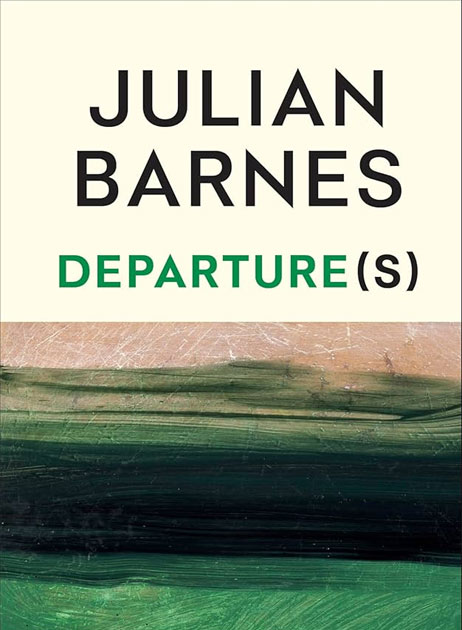
Review By Harsimran Kaur | Rating: 5/5
Departure(s) is a candid take on life; the deception, the frivolity, a bridled economy of socially intensified polemics, and how obfuscated life is. It is primordial, the life, isn’t it? All through our living, we are a witness to the prolix of ‘love’ and ‘hate’ to get convulsed in abstractness of reasoning. Why I love someone, for example, is ethically the right moment to love, then why the right moment to hate the same person becomes a diminishing reality? That is for real too!
Julian Barnes is a potentate, I guess; a ruler of his own destiny, his philosophy, and the power of truth is such that the superfluity of vanity goes into remission. And, recedes it such, that the reader would come across his sander of anecdotes that perceptibly mutate the truth to realize the same truth is a fait accompli. The eclosion of death and diseases having a visceral interest in the body even if you are a human and Barnes is not self-deluded. He appreciates such existence of territorial bumps without remorse, and even if you are dog like Jimmy and not human, who lives through his last days in fraught and stupefaction, no doubt, we all die one day. The dog he talks about is of his friend Jean, and there is an expression in the book that I have become fond of,
“We mostly die lie dogs; I have always believed this.”
Now I believe it too.
Barnes is in his mid-seventies. He has become tolerant to worries as if there is no use worrying in the immanence. Maybe, realization has drawn upon him that death is not a cautious couch to sit on and worry, and neither it is a profligacy subject to defiance, but a conclusion one may systemize that life is always on the edge to another catastrophe or a disquiet calisthenics and with such discriminatory advances, one day the ‘absolute truth’ comes crooning, though its late to welcome it, and it arrives at a juncture when the body has ushered in isolated darkness of falsehood.
Barnes, thus, pauses to reflect, if memory persistently lives inside us or has its days of neural inhibition?
Like the memory of unfinished business of ‘love’; love between two lovers, Stephen & Jean (the same lady who owned the dog, Jimmy), so coming back to their love; it was left to stir its own sour brew in early youth. Now when they meet again after 40 years, thanks to our credible author, love blooms but leaves again. Barnes now lives with a memory ‘is love blasphemous’?
What invoked such a memory? Is it involuntary scepticism? Or is it a spontaneous blur of guilt and shame because he was too a part of the story? Memories have other jobs too. They become an allegory of details rubbed spuriously in the mind, and then one day, we might take a leap of faith along such memories and then with a hold, life will churn our reflections to such memories selling ‘self-love’ as the lecon de vie.
I too have something to add on memory.
Memory and ‘us’ are like opponents in truce. Memories invade without warning, and to combat them is to let them unleash their oppression. Once it is done, and here I would add that like an arrow once loosened cannot return to its bow, and the memory now done with its raging becomes a part of self; it then creates another dimension to our identity, something changes, isn’t it? Like in the war, the arrow of the conqueror begets the conquered. Now if I may ask whose arrow is it anyways? What the arrow brings along is endurance, the memory carries it too all along. Now, how we think about these memories—in maudlin vulnerability or mourn it or see an identity slipping into oblivion or let the truth make another memory?
The book, Departure(s) by Julian Barnes feels like an arabesque; if it ‘feels or ‘sound’, I am less to say but its definitely an arcane of mystified truths. I wish if some instrument could play a gentle arpeggio of such an edification. There is definitely a hint I get of the author, of the life he has led and is currently surviving in. And then I may ask who does not suffer from existential crisis?
Barnes journey with cancer is an all-consuming frigidity with death. Of course he would die of cancer, its given, but then he reflects in shudder, of an all-pervading human compass that life is a farce, prescriptive, and then an all-invading metastasis will pillage the left-over existence. Is there is anything more over-rated than stability of human condition? Then we see death as an eldritch with its entrenched habit of taking away life which is perhaps more stable, voluminous. Then why death, in the angst of superfluity, becomes utterly reprehensible?
Aren’t departures inevitable; of family, friends, first love, kids blooming out and the scared life succinctly toiling hard to finally go away?
There are times, lets be honest, when we feel invincible. I would call it a laboured masquerade of shadowy immortality as if nothing is going to happen to us. if the perceptibility of death on the pyre or a burial, of such an envision if were to become debatable; remember of how we discuss death as if discussing a shopping list, then such an envision is or will be defeated by corporeal adamancy.
Welcome mortality!! Immortality is thus defeated, now tainted with diseases, traumas, distress, old age, and the susurrus of such an appendage makes death a worthy intervention. If I may ask now if it is manageable to think of death vicariously?
I am sure the registrar (you will locate in the book) must have passed a sardonic smile when the entire life of the author, once palmy, comes under scrutiny.
“The cancer is isn’t curable, but it is manageable” (the registrar says)
Let’s get to the departure of his friends, Stephen and Jean. Can the author bow obsequiously to such a separation? Would it have been easy? When they meet again, there is something unusual that worries him. Is it possible to slice humans into temperaments? The cantillations that spring out of such temperaments; does it make human lives encoded around an ethical symbolism, and if it does, are we just about pluralistic expressionism?
There are wicked people around, some with beleaguered anger, and in the arid sequence of life, I have seen many with a solipsistic prelude to recriminations, and the ones with pristine pride that causes abject treachery to the ‘self’. The deceit one causes to the ‘other; is temperament at play here, and if it is then why such infringement is pleasurable?
It looks like the author has attended to his life in full jurisdiction, clasping it in notes, stocking memory. He looks back, in flavour, at the memories. And, now if I may ask if the analogy of memory is existing in the past or does it waver in the ‘present’, in our very being, hidden, so alive that it is inconspicuously ignored?
There is something called Involuntary autobiographical memory talked about in the book. I did feel a feverish apostasy setting in because if one day a crumble of bread leads me to remember the most dispassionate legacy of my life, I am definitely in the undercurrent of moral depredation because if any remembrance is cruel, then what faith I am left with in the present calculus? And if the author is fearful of such a propinquity; sometimes we are too, and in the daiquiri of the past memory and present conflict, emerges a caesura, a break around the memory where the present carries it affections and the past in a serendipity of darkness.
I duly credit Barnes for the composure with which he writes; of what could have been a case of self-pity and guilt becomes a matter to make life manageable. His writing is not all provincialism. Cancer is such a moribund, leaves a monstrosity of dullness but not for him. He prefers to count his blessings in spite of a moratorium; the monotony to life, its survival should not ebb. If cancer tags along, let it be.
Departure(s) is direct as it can be, no aggrandizements of bullish expressionism. There is not a moment of appeasement to the life ordinarily lived with extraordinary deviations. Life is what it is. As Barnes describes,
‘Departures habitually lead to arrival’.
7 Responses
Julian Barnes, you touched me deeply. How special it is to be directly spoken to as one of his readers. thanks for sharing this book review by harsimran kaur
I listened to him narrate his book, in one sitting, and like you, cried at the end.
Great writing style al point are clear thanks
it is very good writing a review
wow it is very nice and super book review thanks
funtastic book review thanks for sharing
This is a very well-written book review; I really liked it, and I would love to read similar reviews in the future.