
Book Review and Critique By Harsimran Kaur | Rating: 5/5
Let’s start with ‘love’.
Is ‘love’ a garden that one must tend to everyday, scrap off the dust of the leaves and let them bloom. If it is then a marvel to see how the soluble affection grows everyday settling somewhere in the moist paste of mud; the water and sunlight penetrating, and what one sees now is an existential outcry of believability. So, doesn’t ‘love’ grow on belief?
And if I don’t tend to love, does it fail or it becomes an empirical liability, or there would come a moment when the reason to love becomes an implication and there is no looking back because to look back would mean tending to it again. It would follow scrutiny, a sclerotic vigilance and a disgruntled monotony to serve it. Are we ready for that?
Here, I must corroborate by saying,
“The cause to love is amorphous but it needs reasons to grow”.
This is exactly what the book tires to capture.
Artie Dam teaches history. He is observant. He is lonely at times. He often thinks,
‘People do die of loneliness, and I am—or will be—one of them.’
So, let’s take it further—Are we all not manifesting loneliness?
We want to speak and we want the entire world to listen to us, and we try hard to make the people around us understand our plight; our outstanding pain and if one were to observe, we are quite proficient to turtle back to our ‘past’ and allow its awkwardness to disturb the ‘present’. Such petulance! But, the order of the world is such that nobody is interested to filter our distress. It seems to them a waste of time. The impact of such impropriety is to finally commiserate with self; thus, loneliness fills in the monotony.
Coming back to Artie, he has an eye for detail. He likes to have conversations with neighbours, is fond of Flossie who is the wife of Reginald (one of their neighbours). Artie is fond of sailing and also carries a secret,
‘He has been thinking to kill himself without his wife or son knowing.’
I thereby ask, why would one think is such a way. Supposedly, ‘death’ is no longer a limitation but just an end to superfluity. Life is beautiful, isn’t it? Life has become our repetitive consolation to dreads; so, threatening, and to the voluminous fears and anxieties, and thereby the imprecation to be alive, if I consider it a monstrosity, to be alive has dismantled the casuistry around death.
What’s more of a curse? They say life is beautiful then why must beauty die?
So, there is a lot that has happened with Artie—his son’s divorce with a new woman entering his life, losing his mother to a mental illness. Now, he is obsessed with dying & when death comes close almost to whip him, he is saved from drowning by a man. Does this incident change Artie? He feels now that his rescue must have been some kind of a conspiracy to set him free from the contemptible thought of dying, and the magic is such that he wants to live now.
There are questions in his mind. I must add here that a question that lingers in the mind for long becomes not a question anymore but an illness for which there might be no cure. Arties grapples with the question of ‘world peace’ and ‘free will’.
Are these two inter-related?
According to me, ‘world peace’ is a presumption as ‘peace’ in itself is a pre-occupied thought—civilized to some & for some it is just the opposite of ‘war’, where catharsis finds its way to objectified guilt.
On the flip side, ‘free will’ is designed, created, experimented with unconsciously in the rim of circumstantial bias. For example, to sit at the corner of my house is ‘free will’ & such obligatory actions seem self-manifested. Again, to deny a relationship of its morality is a conscious choice. One aspect that seems permanent in both the cases is the ‘desire’—a motivated determinism to act.
Considering Artie’s conflict with ‘free will’, he is quite observant to look into the ‘desire’ of the people around him which he does, and also looks into their motivational conspiracy entwined with self-sustenance, and thereby identifies that a ‘free will’ could be a simulacrum of distorted hope or an attempt to synchronize one’s ability to act with self-imposed reasoning. And, if ‘free will’ does exist, is it an escape from fundamental captivity?
He feels full of life again after the drowning incident. Often, we try to be alive in the realm of living & go unnoticeable, isn’t it? It’s only after a churn of misalignments, we are re-born with an entirely different perspective, and such re-births are so many in one life time that to live becomes an unreasonable contradiction, and such is the journey that when we face a catastrophe there is fear that there will never be a re-alignment and at that moment, life starts looking extra-ordinary.
Artie has started living with this belief and I must say that such a thought process is of linear transmigration.
Why he has such opinions? Maybe because that kind of supposition is not an allegory but the shadow he carries of the past.
His mother suffered from psychotic episodes and his sister Maria remained disoriented till her death. The current of the ‘past’ often clasped him, electroeluted him with memories—vivid and penetrable.
How do we define such a ‘past’?
Isn’t ‘past’ a distance one must travel with rapids striking along the beating of the current to experience frisson, an intruding intention to survive, and if it’s a derivative happiness one is looking for; the contempt to look at the past in antagonistic pride must die down.
To look back at sufferings is often desultory, and this is what Artie does, and seemingly one may see all this becomes a deliquescent exaggeration to end his life. The fact that one does not want to live is disturbing. But to believe that one does not deserve to live is a self-styled distortion of reality or a self-proclaimed virtue born of psychological captivity.
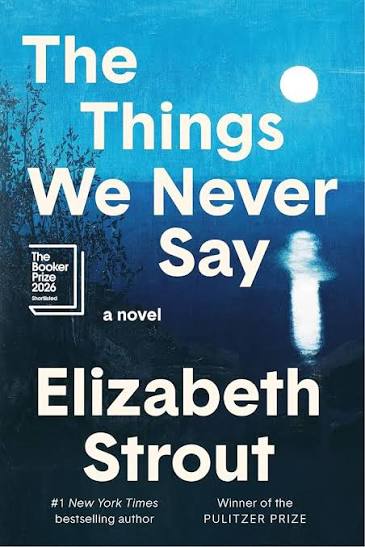
“The Things We Never Say’ by Elizabeth Strout’ is about life—for everyone—you and me—full of possibilities. We stick to some out of sheer obligation, or our receptiveness is a mere conclusive episode to start another. Actually, we don’t want to stop; we want to be on a move. And, through such normalcy, we forget to process what we have gone through. The condemnations, restrains, the sentimental vigilance and the humdrum existence engulfs us but we still move, and in the process, we often forget to the set the equilibrium of expectations.
What does all this amplify—signify—demystify? Such emotions—isn’t it all to sustain, survive?
But we must ask ourselves, is such survival failing us?
The fears that we carry are perhaps an existential threat, and how furtively we carry them inside is as if they were not fears but a coping mechanism. It looks more to me like a preserved forbearance.
So, when Artie asks if there is ‘free will’ in this world—is he hinting at existential capacity? Does all this amount to ‘determinism’; to act as per will or not, and is he trying to dismantle religious autocracy where ‘God’ is the supreme bestower?
The famous French Philosopher, Jean Paul Sartre argued that humans have inescapable freedom to make choices & decisions, and the abstract pause of ‘nothingness’ is but a momentary co-incidence to distance the psychological weight of the past from the relative existence of the ‘present’. It is thus this ‘pause’ that one reflects to make acceptable choices in discretion of one’s own immanence.
Does this account to ‘free will’?
According to me, it’s an awkward conscious absorbing the physical, emotional, moral, intellectual pleasures of self-reflection. So, Artie’s favour of ‘free will’ is a question we must all contemplate.
I would also like to further talk about a quote communicated by Artie to his students, and then let’s reflect on it.
“Do not ever feel that you are superior to someone else. Because you are not. No one is superior to anyone else in the world.”
My take— ‘Superiority’ is a complex phenomenon. Let’s take a further dig. Is it really a phenomenon or a behavioural adequacy?
More digging…Is it a behavioural issue or an act of an unawakened conscious? So, when the matter of conscientiousness takes over, we all consider ourselves superior to all. The reason is simple. We are still not awakened to the truth of collective integrity.
The ‘truth’ must hold humanity in balance; a togetherness to confront any kind of separatism. One must further delve into soul recognition to understand that each being moves in a rather imperfect distorted existence, and such recognition is paramount to create a bridge of structural identity.
A person’s journey is not only defined by its own incessant imperatives but also defined by the people in his life. Agreed, circumstances do make us reclusive, and to watch others through the same prism is heuristic. You learn consistency, coherence, conformity of emotions because a cohesive dependency brims us. Arties sees this through his students Rick, Roper & Danny.
One composes a synchroneity of aberrations among the three students as if their faults are perhaps incisive redemption of an unhealed vitality, and now if time has come, and such time eventually comes when channelising one’s grief must be shaken, must be facilitated as Danny does by inscribing on the wall, or an apology by Rick or for that matter Artie who processes his pain with a recriminating pause. To let it out in such a way maybe an anomaly, but it is still a sorrow, and sorrow has no perfect precision to be absorbed in a particular way.
However, there comes a torrid current of ‘truth’ that Artie must confront, and in his preventive struggle to accept it, one sees in him a pragmatic necessity to create his own ‘truth’ and somehow, it is this refined affection that adds meaning to out otherwise grandiose rectitude.
Here, I take the liberty to extrapolate the nuance of ‘truth’. To know the ‘truth’— the truth of the unclear, unkept, unenvisioned, is in fact never the ‘truth’. It is nothing before it is disclosed. It never exists, not in real—not in imagination. In fact, it is a ghost, wandering from pole to pole to hide because its revelation will bring about an apocalypse, a tragedy of believability, a decomposition of ‘trust’ and a death of belonging. And ‘YES’, ‘truth’ long buried can be cruel, so egregious when exposed as if it must become vindictive to avenge its modesty. For Artie, the ‘truth’ that Rob is not his son—will it alter his emotions or would he surrender?
Inspite of the ‘truth’, Arties feels he still belongs to Rob; Rob belongs to Artie. Sometimes such an identity, such a structural connection is enough to dismantle illusions, strip off the fragility; the falsehood of familiarity. He never tells his wife, Eve, because to tell her the truth is trivializing the fundamentals of belonging. One thing to learn from Artie is this and it is something we must all consider as an indulgence.
The book is strikingly even at the idea of perception. There is perception formed every now & then. Artie finds this conflicting. And if I were to reason it, these perceptive blows by others on one’s subjective existence is in fact an abstract volition to spare themselves from self-scrutiny. So, what people think of Artie does not define his response to life, and should not.
In fact, what he is or expresses to be is an intense determination to be real and I must add here that ‘perceptions’ of others about Artie—it is not that it is fragmented or utterly fragile—but a perception should never become a revulsion.
Perceptions—It is not the finality of one’s being but a process to learn, evolve in matters of such agnostic surveillance.