
Review By Harsimran Kaur | Rating: 4/5
Destiny is cruel; not approachable. It’s an angst, an anomaly. It is a smoke drifting to the other end, the smoke not looking back, clouding the sky like a blurred condensation of life yet to be lived. Yazid is born with a destiny, and in such a destiny of monotony, of uncertainty, of capricious tenderness, he works as a tea seller. What would Yazid call such a destiny where poverty endangers mockery to thereby lie listless as if Yazid were not a human but an abject; an aberrant script of life that nobody wants to spell.
This is the destiny of Yazid as if it were not a destiny but the despicable gallows reaching to the noose to gulp it like an irreverent poison. As Yazid leaves for Rawalpindi from Lahore, he carries venom as if it were not venom but a dilemma of where he should belong, and uncertain is such an unrequited romance with life that one is unaware of where destiny takes, and then it may seem like a finality but then, abruptly, it presents itself with more inequities.
So, is destiny about distractions? Because isn’t distraction a must to contour the contusions; the swelling of such discoloration aches?
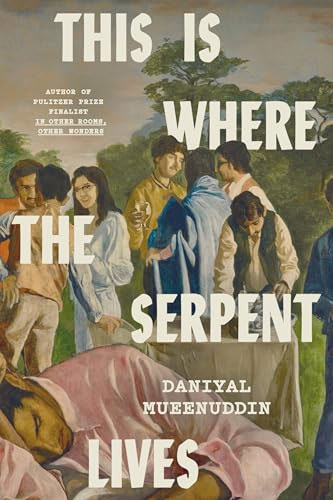
Luminously varied, in desertions and dissensions, ‘This is where the Serpent lives’ by Daniyal Mueenuddin is a story of characters and their self-deprecation. And, with such obsession with the self and shadowy associations, they find distractions to fulfil their destiny.
Hisham, Rustom, Shahnaz, Yazid & Saqib, their hammered associations; a bit dull and a bit dulcet, and then we see them act in perpetuity to be noble yet nebulous, sentimental yet sardonic, ebullient yet eccentric, desirous yet deceitful, righteous yet raffish.
A story of brothers…
Nessim is deceived by his elder brother Hisham for the woman Shahnaz whom he marries. Brotherhood pejoratives, I guess! All then becomes indecent.
Rustom & Hisham – There is a colossal baggage of legacy; an imperturbable consanguinity, and if such continuity defines the permanence of muted personification, we all are beings of existential greed.
I thereby ask, what such an impression imposes?
Rustom has come to Pakistan with an American appetite; the suave and the savoir faire. The Land ownership, the stolid hypocrisy around it is abysmal but the profundity of such a legacy is unsurmountable. It can create a crevice oof envy, hostility. Can Rustom defy such a slather of legacy? Of what impression I hold of Rustom who acts asunder from such association.
Does he really intend to become the anachronistic sahib ordering around, calling to the loud & powerful henchmen or turns out to be a twisted tale of apprehension—to be or not to be.
I then ask you if disassociations, forlorn or forgotten, can ever become a chapter, opened in fear, in strain, and then what becomes of such associations? Does Hisham help Rustom to obliterate the chandios who have rampaged the ancestral fields? Or we see a complete emptying of the past where Rustom gradually is no longer striding the streets of America but layering the toiled, dusty, coarse farming lands of Dunyapur, ingratiating the sheikhs to fight the chandios. Will arrogance become his propriety?
So, is the book about demystifying demagogues or some kind of depoliticization festering deride? Yes, to some extent, but we also see the tail of zamindars, peasantry, land farming ubiquitously spread in the book. Such businesses, as we see, are hooked by ravenous greed for money re-defining the moral scruples. A ribald to add; Do these lands grow crops or some compelling complexity of self-preserved impunity?
Saqib is a character of unease, unfamiliarity usurping the dignities of the rich for he sees them as charlatans gracing the opulence of their richness; the poor wagging its tail behind, smelling the follies of the rich. And yet, the rich have no compunction for such fallacies.
Hisham gives Saqib the power and money to grow vegetables in tunnels. With such power, Saqib looms like a serpent through a devilish conscious. Is such a conscious about to covet the strength of invincibility? Is power a matter of discretion? In the shifting power, Saqib is aggrandised in perfidy and there he carries a self-exculpating pride. But the power of the rich cannot be isolated. It is full of reprobation, people like Hisham who control the poor, in their priggishness, they carry the power to abandon the powerless and then orbit in its perfect monotony. And then they denounce, deprecate, looks like a de jure. Isn’t such a distinction visible in the life we all lead?
As years pass by stretching from 1979 to 2005, all the way to 2013, the places don’t shift. In the travels from Dunyapur to Lahore, somewhere in Karachi to starting the new business of wired vegetables in Ranmal Mohra to the opulence of the Kerala mansion, the characters’ imperfect associations build on to such influences where virtues are destroyed and prejudices remain intact. We see that associations become arbitrary, toxic and such anguish give rise to resentments, mistrust and then there is infidelity, and then power does not look perfect.
So, can the power of rich be deformed by the poor, if a mind like Saqib’s trespasses the extra-ordinary?
Is power only obligatory to the rich?
Is Hisham’s power condescending? So awestruck is he by Saqib’s acumen that he makes him a Munshi of the new venture in farming, but Saqib turns out to be an opportunist to accumulate more power. So, does Saqib’s power become retaliatory?
From picking the dust of Hisham’s household to being under Yazid’s tutelage, Saqib now picks the power pot pourie, using power to blow the fundamental stratifications. It’s ironical that rationality gradually becomes, in the orbit of power, a man’s scrupulous virtue to defend its emotions.
In the quest of Saqib’s disloyalty, the will of his rationality; will it be consciously provoked, and if such conscious prevails that takes the pride of another man to build one’s own associated obsession, do we foresee morality, and if such morality is obsequious to consanguinity, then do we see such morality hugging its promontory jutting to schadenfreude?
Thus, an end comes—a character forming, a character transitioning, a character immersing in seraph or sophistry; the deepening of its essence, now in superfluous vanity, and perhaps a stormeth required to crush the character, not of its physicality but of its curiosity to test power in vicarity.
5 Responses
book review are very interesting keep it up
the book review are really fantastic thanks for sharing information
The book review is very good. I felt very good after reading this book review. Thank you from the heart.
We have read many articles but the quality of this article is different and it has been explained in great detail. Thank you for providing this.
We really enjoyed this book review and would love to read similar books in the future. Thank you for providing this.