
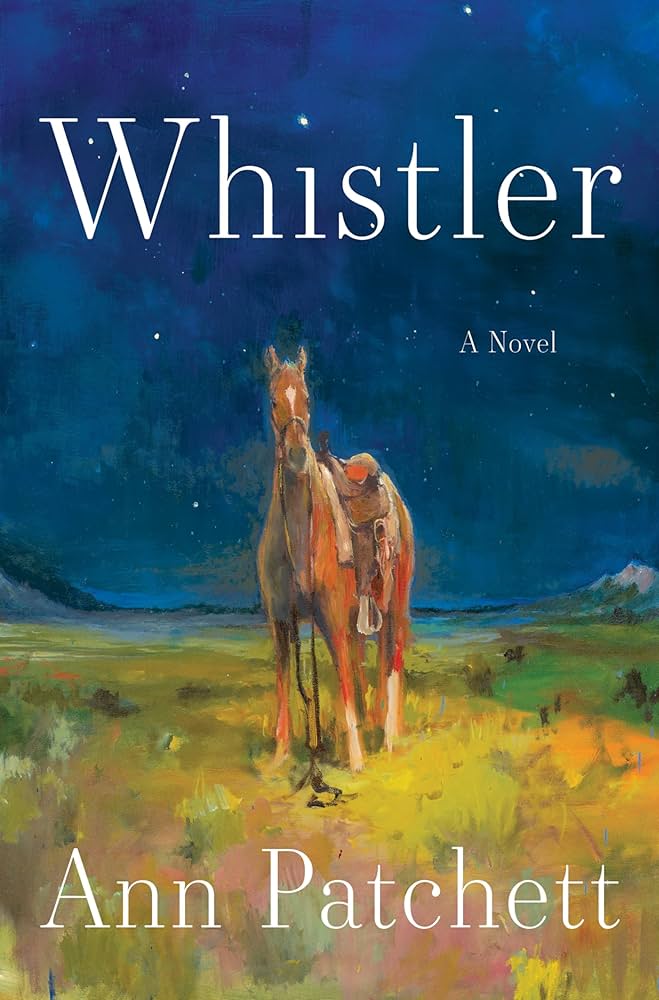
Book Review and Critique By Harsimran Kaur | Rating: 4/5
‘Whistler’ is the sub-conscious that meets you in the darkness, the blankness and in the absurdity of life when nothing makes sense. No doubt, there are triggers that awaken the sub-conscious and the unconscious to comprehend the dormant state of the continuity, when the idea to live; its existential occupancy and intellectual wisdom has become desolate, and such are these triggers; often a recherche because it is more than physical, and then we see the fundamental reasoning taking a back seat, and what is then to be experienced is a restorative belief forming a fluidity of impressionism.
That’s my analysis of ‘Whistler’ but who is ‘Whistler’? In the book, ‘Whistler’ is the horse of Mary who rescues her when she is grappling with the ‘conscious reality’ supplanted by the sub-conscious; the people she has lost in her life, and she herself acts delusional if her life is almost dead but is it? Can there be a time, a distinct space, a moment where life is almost ebbing; seems like an end but there is something called ‘hope’ that rescues one from such moral predicament? It happens to Mary with such certainty that the looming recognition of self, to be alive is propitious. It is a story that Eddie tells Daphne, the story of ‘Whistler’ when both of them are confronted with the frenzied intoxicating ‘death’ that’s stands tall in front of their damaged car, meddled in the rocky terrain of the downward hill, stuck and sabotaged.
Now many years have passed since this incident. Eddie leaves because he is labelled as a disconcerted and careless stepfather to put Daphne in such a soup. Is he really heedless, ill-judged? And, Daphne; what can a girl of nine probably explain to her mother who feels to leave Eddie would be a convenience bereft of further fatalities. Daphne is now 53 when she meets Eddie at the Metropolitan Museum of Arts.
We always talk about complexity in relationships and such complexity arises not from the relation itself but from the nature of acceptance, its believability, the faith we have in it, and above all it stems from the stigmatized morality that we will in.
Such is the relationship between Eddie and Daphne. It feels amorphous, a radiance of a kind that leaves a split darkness of doubt behind, and how beautifully they embrace the light of belonging, even if to belong to one another would be a matter of non-conformity, and I would call such a relationship between Eddie & Daphne of elective affinity.
It all begins 40 years back and ‘childhood’ must be measured to understand the precision of youth and the wisdom of the old. They meet now and the conversations between Daphne & Eddie, though inconvenient, are triggered by an incident that leaves Eddie’s ankle broken & a parched torn skin for Daphne. After all these years, one sees that they still carry a desperation, a desire to know, hear, see each other once again.
Here, at this point, at this juncture, Daphne’s childhood can be extrapolated. One must cogitate if such years of primitive youth are so necessary, so essential to figure out life in its proximity of tenderness & believability, and now to live in the normalcy of unpredictability, can we say Daphne’s childhood after the incident remained restrained? If some say that childhood is meaningless and it isn’t to derive meaning of something and above all is always presumptuous, so it would be better to say that anomalies of childhood are a preserved justification to reason the absurdity of no reasons at all because when there is no meaning, the contradictions become more powerful.
There are arguments, a sense of reckoning full of ordeal; the ordeal of choking in emotions that all through the childhood have spread like a full-filled curse, and then to be free of that wrath, if one were to cogitate, even the scepticism of future cannot brush off the scandalized sorrow of the youth.
Daphne at nine held the moment of incorrigible defeat of not letting Eddie stay. Now we see this passive emptiness after 40 years turn into a raw power. Do we call this a mystic of childhood absorption?
Here, I would explore two sets of relationship;
- Eddie and Daphne
Eddie and Daphne meet after 40 years and there is an attraction, an impulse to disinter what has been left behind, and if the past is now ready to offer an apology? Eddie had his own reasons to get marries to Daphne’s mother. At the age of nine, to now have a father, it was like cutting through the tall grass as if living inside had made Daphne feel abandoned but with Eddie, it was always a moment of adventure, stories. For Daphne, to get back to him was heading home.
- Abigail and Eddie
Abigail is Daphne’s mother. Abigail & Eddie have a past & their decision to be in the past together is a performative convention resisting the moral microcosm but the question does not arise whether they are successful or not but is it so easy to let go off a belief system and our own personal representation to this world? What about our own pleasures and displeasures? Is it too convenient to be what we are not supposed to be? And, what we actually are, why it is surrounded by the tremendous sanity of apprehension?
Can a relationship merely survive on instincts?
There is an enormous culpability one owes to oneself for decisions that feel right at that very moment but turn out to be a catastrophic havoc at a time when the idea or the virtue of an ideal living starts to set in. In such disorder, are we being commiserated for our genuineness or are condemned for our autonomous impulse, or the wrecked part of us needs a validation to now seer in the direction where similar decisions must now be made with utter precision of collected wisdom.
As I was able to explore these relationships, I realized that past is irrevocable, indelible and invincible. There is frank affection attached to the ‘past’ that it sometimes forgets to shed. And, then there is inconspicuous continuity of it in the ‘present’, and the ‘present’ must harbour it in its own mysterious ways and thus wait for the time when its unfinished liaisons with the ‘past’ must unfold, and all this is necessary, almost a perfect synchronicity because the reason to be alive is paramount; a significant conformity to our life lived, and never such a reason must be isolated because, somewhere in the most inappropriate of the circumstances, the reason takes on the finality of standing before us, and then comes clarity putting an end to a crafted surrender.
‘Whistler’, a horse, in the story of ‘Mary’ carries a metaphor of your conscious meeting in the darkness when you are surrounded by blankness and the absurdity of time. You then look at your past in the most profound way as if it were a complex puzzle with hints in the backdrop, and then something crops up to dismantle the performative illusion of such memories.
When Mary is saved by ‘Whistler’, she is perceptibly withdrawn from reality & what she sees around is a layer of memories. Remembrance is tricky, isn’t it? It has its own way of distorting the reality or perhaps ‘reality’ feels almost abandoned in the avalanche of reasons of why it exists today.
This very story becomes a significant conviction for Eddie & Daphne to come out of the woods fine; to not let the paralyzing awareness of their accident lose restraint & faith.
Now, when they meet after so many years, there are conversations, confrontations, crenelations as if the past & present have met after a long time; sympathies overdue and commiserations swallowed. So, this is exactly when an unfinished recourse of life jets relentlessly into the characteristic views of the ‘present’ and then nothing remains stagnant; a continuity flows as if to leave that part of the ‘past’ was in fact a mistake, a collaborative embarrassment, antagonistic rivalry that only provided grief & a bitter repentance.
There is always a past as if with Eddie & Daphne, and with all of us lingering like a swollen tail that needs a panacea, and it must get because the descending fog of heaviness sometimes gets difficult to bear and then one must probe the absurdity that got the ‘past’ and ‘present’ to collide again. In the assertiveness and dubiousness of such life, ‘Whistler’ is the awareness to accept & reclaim.
The unconscious is inside us, thriving, collecting every bit of ontological elements for us to comprehend it, and then to awaken the conscious is almost to create a compass of survival—like ‘Whistler’ who is our unconscious guarding to let us know something is spiralling.
So, does Daphne becomes Eddie’s Whistler?
The book; the idea of reading your own unconscious to understand the complexities delve deep into a perceptible darkness around us that we fail to see, and what is this darkness? And, here I talk about the black curtain wading off the light to not allow the illumination enter making the room a coal crusted cauldron & when we burn in such darkness, does our strength slowly turn into bleakness? Not exactly!
The darkness I wish to talk about is our plans of life; a life resigned to happiness though outwardly scattered into flashes of prosperity as if nothing must be forbidden but these self-exculpating plans may turn the enormity of living into dimness, a pause, a halt from where everything further is a compromise, a correction or a casuistry.
- Daphne never has kids
- Jonathan still has his memories of his first wife
- Eddie is mulled, a bit restricted by his own identity
Did the marriage of Eddie and Abigail withered on a stack of unharboured emotions and maybe they were unequipped to process such sentiments? Is it not that the people who enter your life come with the baggage of their own?
The ‘other’ person sometimes becomes the ‘Whistler’. It could be someone God sent or it could be a pre-ordained, uncontrolled adventure or perhaps could be an intuition or your own unconscious feeding the conscious to be awakened to a resting past and the comprehension of such a ‘pause’ becomes your saviour.
Maybe, you are your own ‘Whistler’!
3 Responses
I usually visit various sites to search for and read book reviews, but I found this particular review quite unique and creative.
This book review is of very high quality.
We really liked this book review.